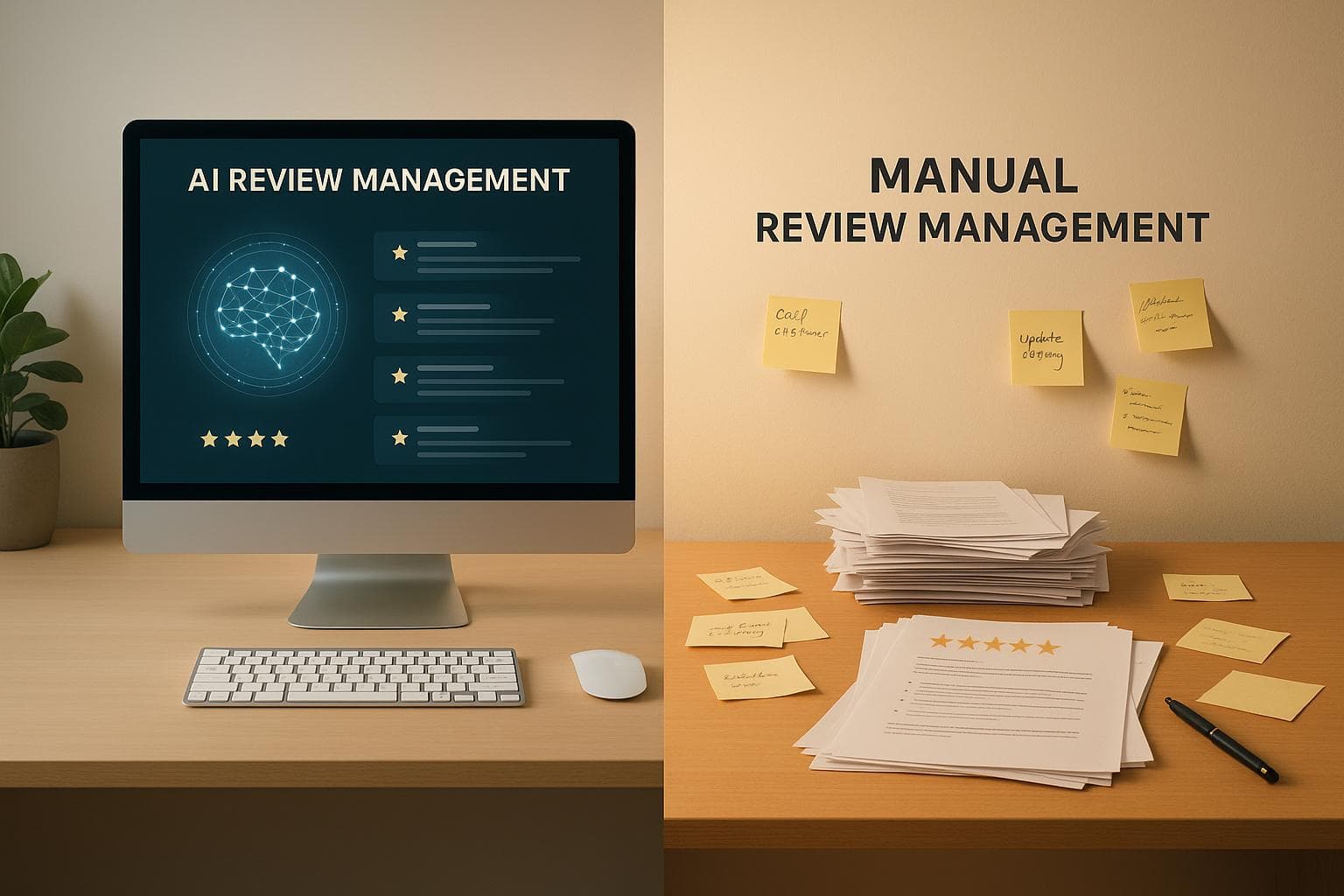
Managing online reviews can make or break a business. Here's the bottom line: AI-driven review management is faster, more accurate, and cost-effective compared to manual methods. While manual review management offers a personal touch, it struggles with speed, scalability, and consistency. AI tools, like CommentAssist, process up to 1,000 reviews per hour with 85–95% accuracy, compared to 10–20 reviews per hour and 60–70% accuracy for manual teams. Businesses using AI also respond to reviews in minutes, avoid costly delays, and often see revenue growth.
Key Takeaways:
- AI systems handle high volumes efficiently, saving time and reducing errors.
- Manual processes are slower, prone to mistakes, and require more resources.
- AI tools provide real-time alerts for negative reviews, improving crisis management.
- Hybrid approaches combine AI's efficiency with human judgment for sensitive cases.
Quick Comparison:
| Metric | Manual Management | AI-Driven Management |
|---|---|---|
| Speed | 10–20 reviews/hour | 100–1,000 reviews/hour |
| Accuracy | 60–70% | 85–95% |
| Response Time | Hours to days | Minutes |
| Cost | Labor-intensive | Fixed SaaS pricing |
| Scalability | Limited by team capacity | Unlimited |
| Crisis Detection | Delayed | Real-time alerts |
For businesses in the U.S., AI is the clear choice for managing reviews efficiently, but manual methods still hold value for complex or sensitive responses. A hybrid approach often works best.
How To Manage Google Reviews 10x Faster With AI
Benefits of AI-Powered Review Management
Switching from manual to AI-driven review management brings a noticeable boost in both efficiency and revenue. These improvements tackle some of the biggest challenges modern U.S. businesses face in today's digital landscape. Let’s dive into how AI’s speed, scalability, and ability to prevent crises give it a clear edge over traditional methods.
Automation and Speed
AI-powered systems completely transform how businesses manage reviews by eliminating the delays associated with manual processes. While manual methods can handle around 10–20 reviews per hour, AI systems can process up to 1,000, ensuring responses are delivered quickly.
This speed advantage becomes even clearer when considering response times. Manual review management often means customers wait hours or even days for replies. In contrast, AI tools like CommentAssist can craft responses within minutes. This quick turnaround not only improves customer satisfaction but also strengthens a business’s reputation.
"The automated responses save us hours every week. We can now focus on improving our service while maintaining excellent online presence." – Michael Rodriguez, Manager, Taste of Italy
AI systems also ensure consistent and professional replies by using pre-set templates. This eliminates the inconsistency, fatigue, or human errors that can creep into manual processes. The result? Reliable and high-quality interactions with every customer.
Managing High Review Volumes
For businesses dealing with large volumes of reviews across multiple platforms, AI solutions offer unmatched scalability. Unlike manual methods, which become more expensive as review volumes grow, AI systems handle increasing workloads without a proportional rise in costs.
By consolidating reviews from all major platforms into one easy-to-use dashboard, AI makes managing feedback more streamlined and cost-effective. This centralized approach allows businesses to monitor and respond to reviews efficiently - something manual methods often struggle to do.
"As a small bakery, managing reviews was overwhelming. CommentAssist helps us respond to every customer promptly and professionally." – Emma Thompson, Owner, Sweet Treats Bakery
AI tools also deliver impressive accuracy. While manual methods typically achieve 60–70% accuracy in interpreting reviews, AI systems consistently reach 85–95%. This increased accuracy ensures that responses are not only faster but also more appropriate to the context of each review.
Real-Time Crisis Prevention
AI’s benefits extend beyond speed and volume - it’s also a powerful tool for spotting potential crises early. These systems send instant alerts for negative or critical reviews, giving businesses the chance to act before issues escalate.
Because they monitor reviews around the clock, AI tools can flag critical feedback even during weekends, holidays, or after business hours when manual teams might be unavailable. Using features like natural language processing and sentiment analysis, tools like CommentAssist can identify emerging problems and prioritize urgent reviews. This proactive approach often turns potential setbacks into opportunities to shine with excellent customer service.
"We've seen a 40% increase in positive reviews since implementing CommentAssist. The AI responses are always professional and helpful." – Jennifer Adams, Principal, Adams Accounting
Problems with Manual Review Management
Managing reviews manually might seem like a straightforward task, but it comes with major drawbacks that can harm both your reputation and your bottom line. These challenges are especially tough for small and medium-sized businesses trying to keep up in today’s fast-moving digital world.
Time and Resource Demands
Handling reviews manually eats up a lot of time and resources. On average, an analyst can process just 10-20 reviews per hour. For a business receiving 500 reviews a day, this means dedicating significant staff time - or hiring multiple full-time employees - just to keep up with review management. That’s a hefty expense for most businesses in the U.S.
But the costs don’t stop there. Delays caused by manual processes can lead to missed opportunities. Studies show that businesses that actively respond to reviews can see revenue increases, while ignoring feedback often results in financial losses.
Plus, the time spent on manual review management pulls employees away from other critical tasks. Managers using manual systems spend 30-40% more time on administrative work compared to those who use AI-powered tools. That’s time that could be better spent on customer service, business growth, or improving operations. And even with all this effort, manual systems come with their own set of accuracy issues.
Human Error and Inconsistency
Manual review management isn’t just time-consuming - it’s also prone to mistakes. With accuracy rates hovering around 60-70%, manual methods often mishandle nearly one-third of customer feedback. This can lead to missed opportunities to address customer concerns or, worse, responses that frustrate customers further.
Several factors contribute to these errors:
- Fatigue affects judgment: A reviewer working on their 50th review late in the day is far more likely to miss important details compared to their first review in the morning. This can lead to generic, unhelpful responses that fail to address specific issues.
- Subjective interpretation: Different reviewers may classify the same feedback differently. For instance, one might see a lukewarm review as neutral, while another interprets it as negative. This inconsistency can make it hard to maintain a professional and unified response strategy.
- Over-reliance on templates: When overwhelmed, staff often fall back on copy-and-paste responses. These generic replies lack a personal touch and can alienate customers rather than building goodwill.
Delays are another big issue. Manual responses can take as long as 15 days or more, and in some cases, reviews might go unanswered for months. During a reputation crisis, these delays can allow negative feedback to spread unchecked on social media, amplifying the damage.
Volume Limitations
Manual systems simply can’t keep up with the demands of modern businesses. Most businesses in the U.S. maintain a presence on 5-7 platforms, such as Google My Business, Yelp, Facebook, TripAdvisor, and others. Checking each platform manually is a time-intensive process that often leaves gaps, especially during off-hours.
The problem gets worse during peak periods. A restaurant might see a flood of reviews after a busy weekend, a retail store during the holidays, or a service business after a big marketing push. Without hiring extra staff, manual systems can’t handle these surges effectively.
For example, if 15 customers complain about slow checkout times across different platforms over two weeks, manual processes might not connect the dots quickly enough. By the time the issue is identified, the damage to the business’s reputation could already be done.
Manual review management also struggles with documentation. Inconsistent records make it difficult to prove compliance with FTC guidelines on authentic reviews and response practices. Without a clear audit trail, businesses may find it hard to demonstrate that they’ve reviewed all feedback or maintained consistent standards - both of which are critical for legal protection in the U.S.
| Challenge Area | Manual Impact | Business Consequence |
|---|---|---|
| Processing Speed | 10-20 reviews/hour | Requires multiple full-time staff for high volumes |
| Response Time | Hours to days | Customer dissatisfaction and lost business |
| Accuracy Rate | 60-70% | Nearly 1/3 of customer interactions mishandled |
| Platform Coverage | Manual check of 5-7 platforms | Critical reviews missed during off-hours |
It’s no surprise that 75% of organizations are expected to adopt AI for review and performance management by 2025. The limitations of manual systems make it clear why businesses are turning to AI tools to handle high volumes and deliver the quick, personalized responses customers now expect.
sbb-itb-5375359
AI vs. Manual Review Management Comparison
When you break down the numbers, it's clear that AI-powered review management outshines manual processes across the board. These differences aren't just about efficiency - they can directly influence your bottom line and the way customers perceive your business.
For starters, manual review management typically achieves an accuracy rate of 60–70%. In contrast, AI systems consistently deliver 85–95% accuracy. That leap in precision not only improves the customer experience but also cuts down on costly mistakes.
Speed is another area where AI takes the lead. While manual processes might take hours - or even days - to address customer feedback, AI systems can generate responses in minutes. This real-time engagement is a game-changer for businesses aiming to stay on top of customer needs.
Performance Metrics Comparison
Here's a closer look at how the two approaches stack up:
| Metric | Manual Review Management | AI-Powered Review Management | Business Impact |
|---|---|---|---|
| Processing Speed | 10–20 reviews/hour | 100–1,000 reviews/hour | AI is 5–100× faster |
| Accuracy Rate | 60–70% | 85–95% | Improves consistency and reduces errors |
| Response Time | Hours to days | Minutes | Enables immediate customer engagement |
| Error Rate | Higher variability | Under 1% | Reduces costly mistakes |
| Cost Structure | Labor cost: $16.50–$50+ per hour | Fixed monthly SaaS pricing | Simplifies budgeting |
| Volume Handling | Limited by staff capacity | Unlimited scalability | Grows with your business needs |
| Platform Coverage | Separate checks for each platform | Unified dashboard monitoring | Ensures all feedback is addressed |
| Crisis Detection | Reactive and delayed | Real-time alerts and escalation | Protects your brand reputation |
These differences highlight how AI not only speeds up operations but also strengthens proactive crisis management - something every business in the U.S. should prioritize.
The financial aspect is particularly striking. Manual review management scales with labor costs, meaning more reviews equal higher expenses. On the other hand, AI solutions like CommentAssist offer unlimited review handling at a fixed monthly rate. This makes budgeting straightforward and supports sustainable growth.
Another critical advantage of AI is its ability to catch negative reviews in real time. Manual systems, limited by human availability, can leave harmful feedback unnoticed for hours or even days. This delay can hurt your brand, whereas AI systems step in immediately to prevent potential crises.
When managing reviews across multiple platforms, the gap widens further. Manual processes require separate checks for each platform, often leading to missed feedback or inconsistent responses. AI consolidates everything into one dashboard, ensuring no review slips through the cracks and your brand voice remains consistent.
Engaging with customer feedback isn't just good practice - it boosts revenue. Businesses that respond to reviews can see an average revenue increase of 12%, while 57% of consumers say they’re unlikely to engage with a business that ignores negative reviews. In this context, the jump in accuracy from 60–70% to 85–95% isn’t just a technical upgrade - it’s a direct investment in your company’s growth and reputation.
Factors for U.S. Businesses to Consider
Deciding between AI and manual review management means weighing the regulatory, customer, and cost challenges that U.S. businesses encounter in today’s digital landscape.
Compliance and Local Requirements
Staying compliant with regulations like the California Consumer Privacy Act (CCPA) and the Americans with Disabilities Act (ADA) is essential for maintaining a positive online reputation. These laws dictate how customer data is managed and require communications to be accessible.
AI tools such as CommentAssist are designed to align with U.S. standards. They format dates as MM/DD/YYYY, display currency in dollars ($), and use American English spelling, helping businesses stay compliant without constant monitoring. For industries like healthcare, compliance is even more critical.
"The HIPAA-compliant responses are crucial for our practice. We can now manage our online reputation while maintaining patient confidentiality".
Manual review processes, on the other hand, may struggle to consistently meet these standards, especially when multiple team members handle responses.
Cultural expectations also play a role in this decision. American consumers expect quick, professional replies that address their concerns without sounding impersonal. AI systems can be fine-tuned to match the local tone and style while delivering the fast responses customers expect. This combination of regulatory and cultural factors often tips the scale in favor of AI solutions.
Cost vs. Efficiency Analysis
Ignoring review management can be expensive. For example, businesses risk losing around $26,000 annually by missing just one job per week due to unresolved negative reviews. Additionally, 57% of consumers avoid businesses that fail to respond to bad reviews, while companies that engage with reviews can see a 12% boost in revenue.
Although manual review management might seem cost-effective initially, rising labor costs make it less efficient as review volumes grow. In contrast, CommentAssist offers scalable pricing: $29 per month for up to 100 reviews, $79 per month for 500 reviews, and $199 per month for unlimited reviews. These costs are often lower than hiring even part-time staff to handle the same workload.
One business reported a 40% increase in positive reviews after adopting AI review management, highlighting how automation can directly improve outcomes. Additionally, managers using AI tools spend 30–50% less time on administrative tasks, allowing staff to focus on activities that drive revenue instead of tedious monitoring.
For businesses experiencing growth, the return on investment becomes even clearer. While manual review costs rise proportionally with volume, AI solutions offer scalable efficiency. For example, a restaurant chain managing 1,000 reviews each month would face significant labor costs with manual management, whereas AI can handle the workload seamlessly.
When to Choose AI or Manual Methods
AI-powered review management is ideal for businesses handling large volumes of reviews, operating across multiple locations, or needing consistent responses across platforms. National restaurant chains, retail franchises, and service providers that process hundreds of reviews daily can benefit from AI’s ability to maintain a unified brand voice .
AI also excels in time-sensitive situations. For instance, if a negative review is posted at 2 AM, AI systems can flag it immediately and generate a response, preventing the issue from escalating before business hours.
However, manual review management still has its place. Boutique law firms, luxury service providers, and businesses dealing with sensitive issues may prefer the personalized touch of manual responses . These companies often handle fewer reviews and can afford to invest more time in crafting thoughtful replies.
Certain situations, such as legal disputes, safety concerns, or deeply personal customer experiences, may require human judgment to ensure the right tone and approach.
Many businesses find a hybrid strategy works best. AI can handle bulk review processing and generate initial responses, while human reviewers focus on escalated cases or high-value customers . This approach combines the speed and consistency of AI with the nuanced understanding that only humans can provide.
Industry-specific needs also influence the choice. Healthcare providers must comply with HIPAA, financial services require strict regulatory accuracy, and hospitality businesses benefit from AI’s ability to manage seasonal review spikes without the need for extra staffing. By balancing these factors, businesses can choose the approach that best aligns with their goals and challenges.
The Future of Review Management
The world of review management is changing fast, with AI-powered tools becoming the go-to solution for U.S. businesses looking for efficient ways to handle their online reputations. As the volume of customer reviews continues to rise, traditional manual methods are struggling to keep up. This shift highlights why AI is taking the lead and how combining it with human expertise can yield the best results.
Let’s break down the key factors behind this trend and the benefits of adding a human touch when necessary.
Why Businesses Are Turning to AI
AI’s appeal lies in its ability to deliver results quickly and accurately. It can process large volumes of reviews with an impressive 85–95% accuracy rate, leaving manual methods far behind.
Speed is a game-changer, especially when it comes to managing potential crises. Tools like CommentAssist can respond to customer feedback within minutes, compared to the hours - or even days - that manual processes might take. This rapid response helps businesses address negative feedback before it spirals out of control. AI also cuts costs by up to 28% while keeping error rates below 1%. As review volumes grow, AI scales effortlessly, whereas manual methods become increasingly expensive and time-consuming.
CommentAssist is a great example of how AI simplifies the process. It consolidates review monitoring across multiple platforms, ensuring no feedback slips through the cracks. At the same time, it maintains a consistent tone and quality in responses across all channels.
The Power of Combining AI and Human Expertise
Despite AI’s clear advantages, the most effective review management strategies don’t rely on technology alone. A hybrid approach - blending AI-driven automation with human insight - provides the best of both worlds. AI handles routine tasks efficiently, while humans step in for more complex or sensitive situations that require careful judgment.
In this setup, AI takes care of the bulk of responses, flagging any exceptions for human review. This ensures that nuanced or high-stakes issues get the attention they deserve.
To make this hybrid approach work, businesses need clear guidelines and regular training. Teams must know when to trust AI’s recommendations and when to step in themselves. Seamless integration between AI tools and human workflows is also key, enabling smooth collaboration that plays to the strengths of both.
As AI continues to evolve, it’s expected to handle increasingly complex scenarios while still benefiting from human oversight for critical cases. This balance will further refine hybrid strategies, leading to better customer experiences and stronger online reputations.
FAQs
How does AI make review management faster and more accurate than manual methods?
AI-powered tools like CommentAssist make managing reviews much simpler by automating tasks such as crafting responses and analyzing customer feedback. This approach saves a lot of time and effort compared to handling everything manually.
With advanced algorithms at work, AI ensures your responses are not only accurate but also consistent and aligned with your brand's voice. Plus, it can spot trends or potential problems early on, allowing businesses to tackle concerns quickly and keep their online reputation in good shape.
What are the limitations of using only AI for review management, and when is it better to combine AI with human input?
AI-powered tools are great for automating tasks like replying to reviews or spotting trends, but they can fall short when it comes to handling more complex or delicate situations. For instance, sarcasm might fly right over an AI's head, or it could struggle to craft a response that truly reflects your brand's unique voice.
That’s where a hybrid approach shines. Pairing AI with human oversight allows you to get the best of both worlds. AI can quickly manage routine tasks, freeing up time, while humans can step in to handle unique or sensitive issues with care and thoughtfulness. This balance helps ensure your interactions remain genuine and aligned with your brand's identity, strengthening the connection with your customers.
How can businesses stay compliant with regulations like CCPA and ADA when using AI tools for managing reviews?
To stay on the right side of regulations like the California Consumer Privacy Act (CCPA) and the Americans with Disabilities Act (ADA) when using AI-powered review management tools, businesses need to focus on two key areas: transparency and accessibility. This means being upfront with customers about how their data is collected, stored, and used, while also ensuring that the platforms they use are accessible to everyone.
Choosing AI tools that are built with compliance in mind is equally important. For instance, platforms such as CommentAssist include features that help businesses handle reviews responsibly while adhering to legal standards. On top of that, regularly updating policies and seeking advice from legal professionals can provide an extra layer of protection to ensure compliance.