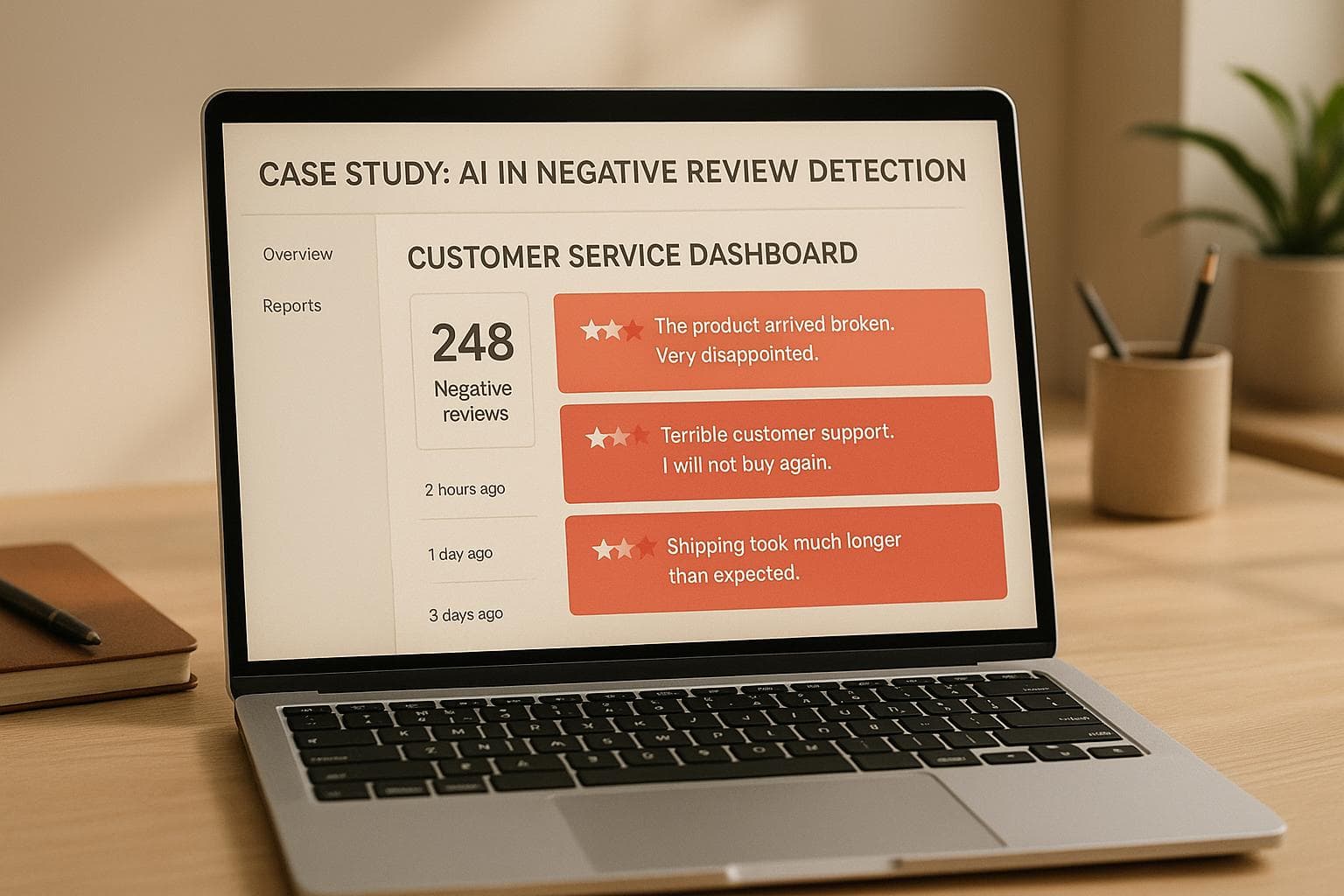
AI tools are changing how businesses handle online reviews. They quickly analyze thousands of reviews, flag negative feedback, and detect fake reviews with high accuracy. Key technologies like Natural Language Processing (NLP) and sentiment analysis allow these systems to interpret tone, context, and even sarcasm. For example, Amazon blocked 250 million fake reviews in 2023, and Yelp's AI achieves 88% accuracy in detecting fake reviews for restaurants and hotels. Businesses using AI for review management report a 25% boost in customer satisfaction and increased revenue.
Key Takeaways:
- Speed: AI processes thousands of reviews in minutes, far faster than manual methods.
- Accuracy: Systems like Amazon's achieve 91% accuracy in detecting fake reviews.
- Business Impact: Companies responding to reviews with AI see a 12% revenue increase on average.
- Tools: Platforms like CommentAssist automate review responses and provide insights to address customer concerns effectively.
AI is essential for maintaining online reputation and improving customer relationships in today’s fast-paced digital environment.
Psychologist's Fake Reviews Evade Google's AI-Enhanced Detection
Methods for Detecting Negative Review Trends
AI-driven review detection relies on cutting-edge algorithms to analyze language and uncover patterns. These systems use a mix of techniques to create a solid framework for identifying negative or potentially fraudulent reviews. This technical foundation plays a key role in modern review management systems, as highlighted in the upcoming case studies.
Natural Language Processing and Sentiment Analysis
At the heart of today’s review detection systems is Natural Language Processing (NLP). By scanning reviews for specific linguistic markers - like negative words such as "disappointed", "poor", or "terrible" - NLP can identify signs of customer dissatisfaction. It doesn’t stop at surface-level analysis; NLP dives deeper, examining phrases and context to pick up on subtleties like sarcasm or implied negativity.
Building on this, sentiment analysis scores reviews on an emotional spectrum, ranging from highly negative to highly positive. For instance, in a study involving around 40,000 Amazon reviews, researchers used sentiment analysis with predefined thresholds and achieved an impressive 91% accuracy in spotting suspicious reviews. Beyond accuracy, AI systems excel in speed, analyzing thousands of reviews in a fraction of the time it would take a human, all while maintaining consistent results.
Machine Learning Models for Review Classification
AI systems also lean heavily on machine learning models to classify reviews. Two commonly used models are Random Forest and logistic regression.
- Random Forest models analyze complex patterns by building multiple decision trees. Each tree evaluates factors like word choice, sentence structure, and user behavior. The combined results deliver a more reliable classification. When paired with sentiment analysis, these models have achieved a 91% accuracy rate.
- Logistic regression, on the other hand, calculates the likelihood that a review belongs to a specific category. For example, when applied to Yelp reviews for restaurants and hotels, this method reached 88% accuracy in identifying fake reviews. These models are trained on massive datasets of labeled reviews, allowing them to adapt to the ever-changing landscape of genuine and fraudulent feedback.
Recent advances in feature-based machine learning have pushed precision rates even higher. Some systems now boast precision rates of up to 99.34% when detecting AI-generated fake reviews. To evaluate these methods, specific performance metrics are used.
Metrics for Measuring AI Performance
The success of an AI review detection system is judged using three main metrics: accuracy, precision, and recall.
- Accuracy measures how often the system classifies reviews correctly. Studies show accuracy rates of 91%, meaning 91 out of every 100 reviews were accurately identified.
- Precision focuses on the flagged reviews, measuring how many of them are genuinely problematic. Advanced systems have reached precision rates of up to 99.34%, significantly reducing false positives.
- Recall evaluates how well the system captures all actual negative or fake reviews, ensuring comprehensive detection.
The table below breaks down these metrics and their business relevance:
| Metric | What It Measures | Business Impact | Benchmark Performance |
|---|---|---|---|
| Accuracy | Overall correctness of classifications | Boosts reliability and ROI | 88–91% (Amazon, Yelp studies) |
| Precision | Proportion of flagged reviews that are problematic | Reduces false positives | Up to 99.34% (advanced systems) |
| Recall | Proportion of problematic reviews detected | Ensures thorough detection | Varies by platform and model type |
Performance can vary depending on the platform and type of reviews. For example, an analysis of the Apple App Store found that about 35% of all reviews were fake. In one extreme case, a single spammer was responsible for posting 60,000 fake reviews. These findings highlight the importance of accurate and efficient AI systems, especially for businesses in the U.S. managing large volumes of customer feedback.
These metrics provide a foundation for understanding how AI systems perform in real-world applications, which will be explored further in the next section.
Case Study: AI in Review Detection Applications
AI is making waves in identifying and managing fake reviews on a massive scale. These case studies showcase how different industries are leveraging AI to handle this challenge effectively.
Amazon's AI-Driven Review Monitoring

Amazon employs advanced natural language processing (NLP) and machine learning to analyze review patterns and monitor reviewer behavior. This system flags suspicious accounts, especially those posting duplicate or multiple reviews.
In 2023 alone, Amazon's AI tools blocked over 250 million fake reviews and identified more than 23,000 social media groups - with nearly 50 million members - engaged in fake review schemes. Research indicates that AI models can detect fraudulent reviews with an impressive 91% accuracy. These efforts not only protect consumers but also ensure fair competition for legitimate sellers.
Yelp's Sentiment Analysis for Restaurants and Hotels

Yelp uses sentiment analysis and logistic regression techniques to filter out fake reviews. With 88% accuracy, their system evaluates factors like writing style, reviewer history, and timing patterns. The AI model continuously learns, adapting to new tactics employed by fake reviewers. This approach ensures that businesses receive accurate ratings, helping them build trust with customers.
App Store Review Classification
Managing millions of app reviews is no small feat, and the Apple App Store relies on AI to tackle this challenge. By analyzing text patterns, submission timing, and reviewer behavior, AI models classify reviews and detect suspicious activity.
A study of over 22 million reviews across 1.4 million apps revealed that 35% of the reviews were fake, amounting to roughly 66 million reviews. In one case, a single spammer was responsible for posting 60,000 fraudulent reviews, showing how AI can uncover large-scale abuse. These tools help app developers quickly respond to coordinated attacks, safeguarding user trust and maintaining the platform's integrity.
Here’s a quick comparison of AI applications across these platforms:
| Platform | AI Technique | Key Results | Business Impact |
|---|---|---|---|
| Amazon | Machine Learning + Behavioral Analysis | 250 million fake reviews blocked (2023) | Protects consumers and supports fair competition |
| Yelp | Logistic Regression + Sentiment Analysis | 88% fake review detection accuracy | Ensures genuine business ratings |
| App Store | Pattern Recognition + Classification | 35% of reviews identified as fake | Maintains user trust and developer fairness |
These examples highlight how AI is actively combating fake reviews, benefiting both consumers and businesses. They also provide a solid foundation for companies aiming to protect their online reputation in a rapidly evolving digital landscape.
sbb-itb-5375359
Results and Business Impact
The case studies highlight how businesses are transforming their approach to managing negative reviews with the help of AI. From improving detection accuracy to boosting revenue and customer relationships, AI is proving to be a game-changer.
Better Accuracy in Negative Review Detection
AI models are setting new standards for precision in identifying negative reviews. For example, a feature-based machine learning system recently achieved an impressive 99.34% precision in detecting reviews written by ChatGPT. This surpasses the capabilities of traditional manual moderation by a wide margin.
Platforms like Amazon and Yelp are also seeing strong results. Amazon's sentiment analysis system delivers 91% accuracy in identifying fake reviews, while Yelp's logistic regression models achieve 88% accuracy for restaurant and hotel reviews. With this level of precision, businesses can effectively separate genuine customer concerns from malicious or fake content. This reduces the risk of overlooking valid negative feedback while maintaining focus on actionable insights.
Business and Financial Benefits
AI-powered review detection is not just about accuracy - it’s also driving measurable financial gains. Research shows that businesses using AI-driven sentiment analysis experience an average 25% increase in customer satisfaction, which directly impacts customer retention and revenue growth.
Companies that actively engage with reviews often see tangible financial returns. For instance, one business protected $20,000 in revenue with just a $1,788 investment in AI technology. Additionally, responding to more reviews with AI assistance can improve local Google Maps rankings, leading to increased organic traffic and attracting more potential customers. This creates a ripple effect, where short-term gains in revenue and visibility lay the groundwork for lasting customer satisfaction.
Long-Term Impact on Customer Satisfaction
Beyond immediate financial benefits, AI systems help businesses build stronger, long-term customer relationships. By quickly identifying and addressing negative feedback, companies can foster trust and loyalty through timely and consistent communication.
Some businesses report up to a 20% improvement in customer satisfaction scores after adopting AI review management systems. These systems also help identify recurring issues in negative reviews, allowing companies to resolve problems before they escalate and damage their reputation.
Consistent AI-assisted review responses have also contributed to sustained high ratings. Many businesses report maintaining 4.8-star averages across review platforms. Over time, this leads to increased brand loyalty, higher customer lifetime value, and greater resilience against challenges to their reputation.
Using CommentAssist for Negative Review Detection and Response
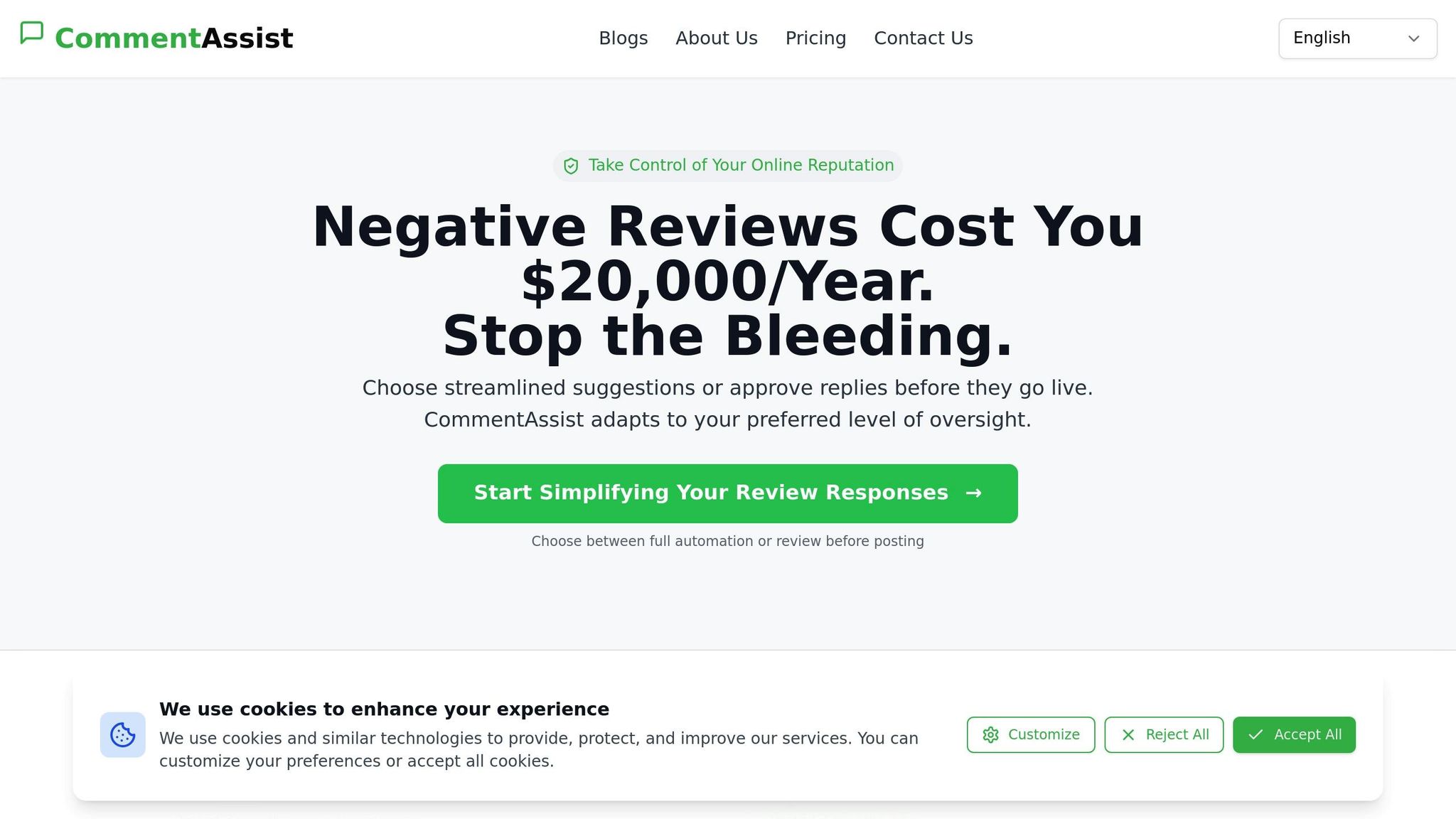
Based on our case study findings, CommentAssist demonstrates how AI tools can efficiently handle negative reviews. This platform offers automated solutions for US businesses, helping them detect and respond to negative feedback in a timely manner. By doing so, it not only safeguards online reputations but also reduces the manual effort required to manage reviews.
CommentAssist Features for Review Management
CommentAssist comes packed with tools to simplify review management. Its automated review response system uses natural language processing and sentiment analysis to craft appropriate replies to negative feedback. This ensures businesses can address customer concerns quickly and professionally, often resolving issues before they escalate further.
The platform's analytics dashboard offers real-time insights into review trends. It tracks the percentage of negative feedback, measures how effective responses are over time, and pinpoints recurring issues in customer reviews - helping businesses identify and tackle underlying problems.
With multi-platform integration, CommentAssist connects seamlessly with major review sites like Google, Yelp, Facebook, and TripAdvisor via secure APIs. This centralized system allows customer service teams to manage reviews from one dashboard, ensuring consistent and timely engagement across all platforms.
Custom response templates are another standout feature. These templates let businesses maintain their brand voice while addressing different types of negative feedback. For instance, a retail chain can use tailored templates for product complaints, shipping delays, or service issues, ensuring every response feels genuine and aligns with company policies.
Here’s a real-world example: A mid-sized hotel chain in the US used CommentAssist to manage reviews on Google and Yelp. Within just three months, they saw a 30% drop in unresolved negative reviews and a 15% boost in their average customer ratings. Automated responses allowed the team to address guest concerns faster, while analytics revealed recurring cleanliness issues, enabling targeted improvements.
These features are available through flexible pricing plans, making the tool accessible for businesses of all sizes.
CommentAssist Pricing Plans for US Businesses
CommentAssist offers three pricing tiers to suit various business needs:
| Plan | Monthly Price | Review Limit | Key Features | Best For |
|---|---|---|---|---|
| Starter | $29 | Up to 100 reviews | Basic AI response generation, Google Business Profile integration, email support, basic analytics | Small businesses with fewer reviews |
| Professional | $79 | Up to 500 reviews | Advanced AI responses, Google & Yelp integration, priority support, custom templates, team collaboration | Growing businesses needing multi-platform support |
| Enterprise | $199 | Unlimited reviews | Premium AI responses, all platform integrations, 24/7 support, custom analytics, API access, dedicated account manager | Large organizations managing high review volumes |
The Enterprise plan stands out for its extensive features, including custom integrations and dedicated support, making it ideal for businesses that handle a large number of reviews.
Integration and Continuous Improvement
CommentAssist’s integration capabilities make review management even smoother. By connecting business accounts through secure APIs, the platform consolidates reviews, analyzes sentiment, and automates responses - all from a single dashboard. This streamlined workflow saves time and ensures consistency.
The platform’s analytics also promote continuous improvement. Regular reports help businesses monitor the effectiveness of their responses, spot trends in negative feedback, and adjust their customer service strategies as needed. Companies can refine their response templates based on customer reactions and proactively address emerging concerns.
To maximize impact, CommentAssist suggests responding to all negative reviews within 24 hours using empathetic, solution-oriented language. By acting on these insights, businesses can shift from merely reacting to feedback to actively building their reputation. This approach not only resolves customer issues but also turns dissatisfied individuals into loyal supporters, reinforcing the importance of real-time reputation management.
Conclusion: The Role of AI in Negative Review Detection
Our case study analysis highlights how AI-powered tools for detecting negative reviews are becoming indispensable for businesses in the United States. These systems have evolved from being experimental to delivering measurable results, directly influencing customer satisfaction and overall business performance. They don’t just identify issues but also provide insights that help businesses make strategic improvements.
Key Insights from the Case Study
The findings from the case study confirm that AI-driven review management excels in three critical areas: accuracy, speed, and actionable insights. AI systems have achieved accuracy rates of nearly 90% in identifying problematic reviews - far surpassing manual methods. This level of precision underscores the reliability of AI in handling tasks that can be prone to human error.
In addition to accuracy, the efficiency of these systems is transformative. AI tools can analyze thousands of reviews in just minutes, flagging negative sentiment and identifying patterns that might take human teams hours - or even days - to uncover. This speed ensures businesses can respond quickly, addressing issues before they escalate. According to Gartner research, companies using AI for review management have reported customer satisfaction improvements of up to 25%, with some averaging a 20–25% increase.
But AI doesn’t stop at detection. These tools dig deeper, uncovering the root causes of customer dissatisfaction. By identifying recurring issues, businesses can take proactive steps to improve their products and services, leading to long-term gains in customer loyalty.
The Future of AI in Review Management
As AI technologies continue to advance, the future of review management looks even more promising. One emerging challenge is the rise of AI-generated fake reviews, which calls for sophisticated detection strategies . Future systems will likely incorporate multi-layered approaches, combining linguistic analysis, behavioral data, and network monitoring to combat coordinated fake review campaigns effectively.
Another key trend is the integration of AI with human oversight. While AI excels at processing vast amounts of data, human judgment adds critical context and nuance. This collaboration ensures that businesses benefit from AI’s efficiency without losing the personal touch needed for complex decision-making.
Looking forward, businesses in the United States can expect AI review management tools to integrate more seamlessly with their operations. Features like real-time monitoring, predictive analytics, and automated responses will become standard, enabling companies to maintain their online reputation with minimal effort. These advancements will not only enhance customer satisfaction but also drive continuous business growth.
The takeaway is clear: AI-powered tools for detecting negative reviews have moved beyond being just a technological advancement. They are now a necessity for businesses looking to safeguard their online reputation and thrive in the digital age.
FAQs
How can AI identify sarcasm or subtle negativity in reviews, and why does it matter for businesses?
AI picks up on sarcasm or implied negativity in reviews by examining context, tone, and word patterns through natural language processing (NLP) and sentiment analysis. These advanced tools can detect when a comment that appears positive actually has a negative twist, like sarcasm, or when subtle phrasing signals dissatisfaction.
This ability is a game-changer for businesses. Overlooking these nuances could mean missing critical customer concerns, which might harm a brand’s reputation. By spotting and addressing such reviews, companies can strengthen customer relationships, boost their online image, and tackle potential problems before they grow into bigger issues.
How do Random Forest and logistic regression models differ in classifying reviews, and how do these differences impact accuracy?
Random Forest and logistic regression take very different approaches to classifying reviews, each with its own strengths and limitations. Logistic regression is a straightforward, linear model that's ideal when the relationship between variables is clear and predictable. It’s often favored for its simplicity, speed, and ease of interpretation, particularly when working with smaller datasets.
In contrast, Random Forest is a more advanced, non-linear model that relies on a combination of decision trees to make predictions. This makes it particularly effective at handling large datasets and uncovering intricate patterns, especially when the data relationships are complex or non-linear. However, this added complexity comes at a cost - it demands more computational power and is harder to interpret compared to logistic regression.
Ultimately, the choice between these models hinges on the nature of the dataset and the specific objectives of the classification task. For instance, Random Forest might be better suited for identifying subtle patterns in negative reviews, while logistic regression could be a practical choice for simpler, more straightforward scenarios.
How can businesses use AI tools to identify and address negative reviews to boost customer satisfaction and revenue?
AI-powered review detection systems enable businesses to spot patterns in negative feedback with speed and precision. When companies address these reviews quickly and thoughtfully, they can resolve customer concerns, boost their online ratings, and build stronger, long-lasting customer relationships.
These systems also provide valuable insights into recurring problems, helping businesses make smarter decisions to enhance their products or services. The result? Happier customers and, ultimately, increased revenue.