Online reviews can make or break your local business. They influence customer trust, search rankings, and even revenue. Here's why they matter:
- 13% of Google's Local Pack ranking depends on reviews.
- 91% of consumers base decisions on reviews.
- Businesses with over 30 reviews earn 10% more monthly revenue.
To grow, focus on these 7 metrics:
- Review Volume & Growth: More reviews build credibility, but steady growth is key.
- Average Rating & Distribution: A 4.2-4.5 star rating feels trustworthy.
- Review Recency: Recent reviews matter more to customers and Google.
- Response Rate & Time: Replying quickly (within 1-2 days) shows you care.
- Sentiment & Themes: Analyze feedback to spot areas for improvement.
- Review-Driven Actions: Track clicks, calls, and visits from reviews.
- Search Visibility: Reviews directly impact your local search ranking.
Pro Tip: Tools like CommentAssist automate review management, saving time and boosting response rates. Start tracking these metrics to improve visibility, build trust, and drive growth.
Is Your #1 Local SEO Metric Actually Putting Money in Your Pocket?
sbb-itb-5375359
1. Review Volume and Growth Trend
When it comes to your online reputation, the number of reviews and how they grow over time are key factors to pay attention to. Review volume - the total number of reviews your business has collected on platforms like Google, Yelp, and Facebook - plays a major role in Google's "prominence" signal. In simpler terms, the more reviews you have, the more trustworthy and established your business looks in local search results.
But it's not just about how many reviews you have. Review velocity, or how quickly you're getting new reviews, is just as important. Each fresh review breathes life into your listing and shows that your business is active and relevant. For example, earning 200 reviews over two years is far more credible than gathering the same number in just a week.
"Local SEO experts believe that a steady stream of reviews (instead of sudden bursts of reviews) positively impact local rankings." - Miriam Ellis, Local Search Columnist
Sudden jumps in review numbers can raise red flags for both Google's algorithm and potential customers. These spikes might lead to reviews being removed or even penalties if they seem unnatural. Plus, research shows that most shoppers need to see at least 11 reviews before they start trusting a business's rating. So, building a steady flow of reviews over time is a much more reliable way to establish credibility than a one-time surge.
Keeping an eye on these trends not only improves your visibility but also helps you create smarter review management strategies. A steady increase in reviews shows strong customer interaction and can be sustained more easily by automating review requests with tools like CommentAssist. While review volume gives a snapshot of your reputation, other metrics can provide deeper insights into your performance - which we'll dive into next.
2. Average Rating and Rating Distribution
Your average star rating is one of the first things potential customers notice - and it plays a big role in how Google ranks your business. In fact, reviews make up about 13% of the ranking weight for Google's Local Pack (the top three local results) and around 7% for general organic search. This makes your rating a critical factor in your business's online visibility.
But focusing solely on your average rating doesn't give the full picture. The distribution of your ratings - how many 1-star, 2-star, or 5-star reviews you have - offers deeper insights. For instance, a business with a 4.6 average rating and a mix of reviews often feels more credible than one with a perfect 5.0, which might come across as too good to be true.
"A negative review that has been handled correctly can be as much of a positive spotlight on the brand as a glowing review." - Richelle Peace, Content Marketing Specialist, AgencyAnalytics
Examining your rating distribution can also reveal areas needing attention. A pattern of 1- and 2-star reviews may point to operational issues that require fixing. On the flip side, analyzing your 5-star reviews can show you what customers love most about your business, helping you refine your marketing. Tools like CommentAssist can simplify this process by using sentiment analysis to identify recurring themes, saving you the hassle of manually combing through reviews.
Online reviews carry significant weight in consumer decisions. A whopping 79% of people consider online reviews when deciding on a local business, and 91% rely on them regularly. Your rating distribution doesn't just impact how customers perceive you - it directly affects your search rankings and revenue. By working to earn genuine 4- and 5-star reviews while thoughtfully addressing negative feedback, you can boost both your visibility and your bottom line. Next, we’ll look into how the timing and frequency of reviews can shed even more light on your business’s performance.
3. Review Recency and Posting Frequency
A review from three years ago doesn't carry the same weight as one posted just last week. In fact, 73% of consumers only pay attention to reviews from the past month. This highlights a key issue: even if your overall rating looks great, an outdated review profile could quietly hurt your business.
As Richelle Peace, Content Marketing Specialist at AgencyAnalytics, explains:
"It won't look very good to your client's potential new customers when they search their business online and find reviews from 2015. How much faith would you put into a restaurant review from nearly a decade ago?"
Timing matters - not just in terms of customer trust but also for local search rankings. Review signals like recency and frequency contribute to about 17% of the factors influencing local pack rankings. Google tends to prioritize reviews from the last few months, and new reviews can impact rankings in just days. This means a business with fewer but consistently recent reviews might rank higher than one with a large, outdated review base.
Consistency is key. A steady flow of 4–10 reviews per month sends a stronger signal to Google's algorithm than a one-time surge, which could even get flagged as suspicious. To keep this momentum, aim to collect reviews regularly rather than in bursts.
The simplest way to achieve this is by requesting reviews within 24–48 hours of a purchase or service - while the experience is still top of mind. Automating this process with tools like post-sale emails or SMS messages ensures you maintain a steady stream of recent reviews. Platforms like CommentAssist can simplify this, sending out requests at the perfect time without requiring manual follow-ups for every customer interaction.
4. Response Rate and Response Time
Gathering reviews is just one piece of the puzzle; how you respond - and how quickly - shows customers that you genuinely care about their feedback.
Response rate is the percentage of reviews you reply to, while response time measures how fast those replies are posted. Together, they play a huge role in building trust. Research shows that 88% of consumers are more likely to choose a business that replies to all reviews, compared to just 47% who would consider one that ignores them. That’s a massive difference - and it’s entirely up to you to close the gap.
Most customers expect a reply within 7 days, but nearly a third hope to hear back within just 3 days. To meet these expectations, aim to respond within 24–48 hours for most reviews, and under 24 hours for negative ones. As Marissa Amenta of Local Data Exchange aptly puts it:
"It's not the bad review that hurts, it's the bad response or total silence."
Responding to reviews doesn’t just build trust - it also enhances your Google Business Profile. Each response adds fresh content, which can improve your visibility in local searches. Businesses with a response rate above 30% often see an 18% increase in repeat purchases. Yet, surprisingly, only 5% of businesses consistently respond to their reviews. That leaves a huge opportunity for those willing to engage with their customers.
If managing a high volume of reviews feels overwhelming, tools like CommentAssist can simplify the process by automating responses and sending real-time alerts. This ensures no review goes unanswered without requiring significant extra effort.
5. Review Sentiment and Recurring Themes
Once you've streamlined response efficiency, it’s time to dig deeper into the content of reviews. While star ratings give a quick sense of customer sentiment, the real insights lie in the review text. Sentiment analysis helps uncover the tone behind reviews, offering a clearer view of your strengths and areas needing improvement - beyond what a simple 1–5 star scale can show. Combined with metrics like review volume, average rating, and recency, this creates a fuller picture of your local reputation.
Recurring themes in reviews can act as a guide for action. For instance, if multiple customers mention slow checkout times, praise a particular employee, or highlight a specific product, it signals where adjustments might be needed. AI tools can simplify this process by categorizing feedback into topics like "customer service", "pricing", or "product quality." Platforms such as Google, Yelp, and Facebook become much easier to navigate when feedback is grouped this way, making patterns easier to spot.
Take this example: In 2025, a fast-casual Mexican restaurant leveraged Rio SEO's sentiment analysis and Text Analytics tools to address trends in their reviews. Within just two months, they saw a 32% jump in five-star reviews, their average rating rose from 4.2 to 4.4, and they successfully eliminated one-star reviews.
"Analyze recurring issues and make necessary changes to enhance your products or services. This proactive approach can turn a negative experience into a positive outcome for your business." - Yulia Deda, SEO and Content Marketing Expert, SE Ranking
A simple way to start is by checking the "popular phrases" section on your Google Business Profile. This feature highlights the words customers most frequently use to describe your business, giving you a quick, free snapshot of how your brand is perceived. Combine this with tools like CommentAssist, which provides built-in analytics to help you track sentiment changes over time and respond to feedback in ways that show you’re truly listening. These insights pave the way for taking review-driven action, which will be explored in the next metric.
6. Review-Driven Actions and Conversions
Understanding how customer feedback translates into behavior is key to driving results. Measuring review-driven actions helps you see how reviews influence activities like calls, website visits, requests for directions, and even in-store purchases.
Your Google Business Profile (GBP) Performance dashboard is a great place to start. It tracks actions that signal strong purchase or visit intent - such as click-to-call, requests for driving directions, and website clicks. Reviewing these metrics over a consistent 3-month period can help you spot trends and growth opportunities. Here's a quick breakdown of key actions and what they indicate:
| Tracked Action | What It Signals |
|---|---|
| Click-to-Call | Strong intent to purchase or inquire |
| Driving Directions | Likely in-store visit |
| Website Clicks | Research phase or potential online sale |
| UTM‑Tagged Visits | Direct ROI from local search efforts |
| Appointment Clicks | Service demand and revenue potential |
To dig deeper, use UTM parameters in your GBP website link (e.g., ?utm_source=google&utm_medium=gbp). This allows you to track traffic in Google Analytics 4 and directly connect visits to conversions. By doing so, you can clearly link online activity to real-world business outcomes.
Studies show that customer reviews can boost conversion rates by up to 270%. Additionally, 76% of smartphone users who search for local businesses visit one within 24 hours.
For brick-and-mortar locations, consider integrating call tracking and POS systems. These tools can help you tie review interactions directly to sales, allowing you to make informed decisions on spending, like adjusting cost-per-acquisition targets by ZIP code.
"Success is now contingent on your brand's ability to craft seamless customer experiences that are rooted in a deep understanding of how people find, engage with, and choose local businesses." - Rio SEO
7. Local Search Visibility Tied to Reviews
Your reviews play a direct role in determining how visible your business is in local search results. According to Moz's Local Search Ranking Factors, review signals contribute about 17% to local pack ranking factors, making them the second most important factor after Google Business Profile signals. Google even states: "Google review count and review score factor into local search ranking".
The three most important aspects of reviews for local search are volume, rating, and recency. Businesses with more than 100 reviews are 2.3 times more likely to rank in the top three compared to businesses with fewer than 10 reviews. While having a high average rating is essential, context matters. For example, a business with a 4.7-star average and moderate review volume will generally outrank a competitor with a 3.2-star rating, even if the competitor has significantly more reviews. Additionally, when users search for "best" or "top" businesses, only those with a 4.0-star rating or higher are eligible to appear.
Recency is another key factor - both for potential customers and Google's algorithm. A steady stream of 4–8 new reviews each month shows ongoing activity, which carries more weight than a sudden spike in reviews followed by inactivity. Beyond just collecting reviews, how you respond to them can also improve your local search performance.
"A business that gets five reviews per week sends a very different signal than one that got 50 reviews two years ago and nothing since." - ReviewGen Team
Think of review responses as an opportunity for SEO. Google analyzes the text in reviews and owner responses for keywords related to services, products, and locations. Including natural mentions of your services or area (e.g., "Thanks for choosing us for your HVAC repair in Austin!") can enhance your relevance for specific search queries. Tools like CommentAssist can simplify the process, helping you maintain a response rate above 80%, which is linked to better local rankings.
Comparison Table
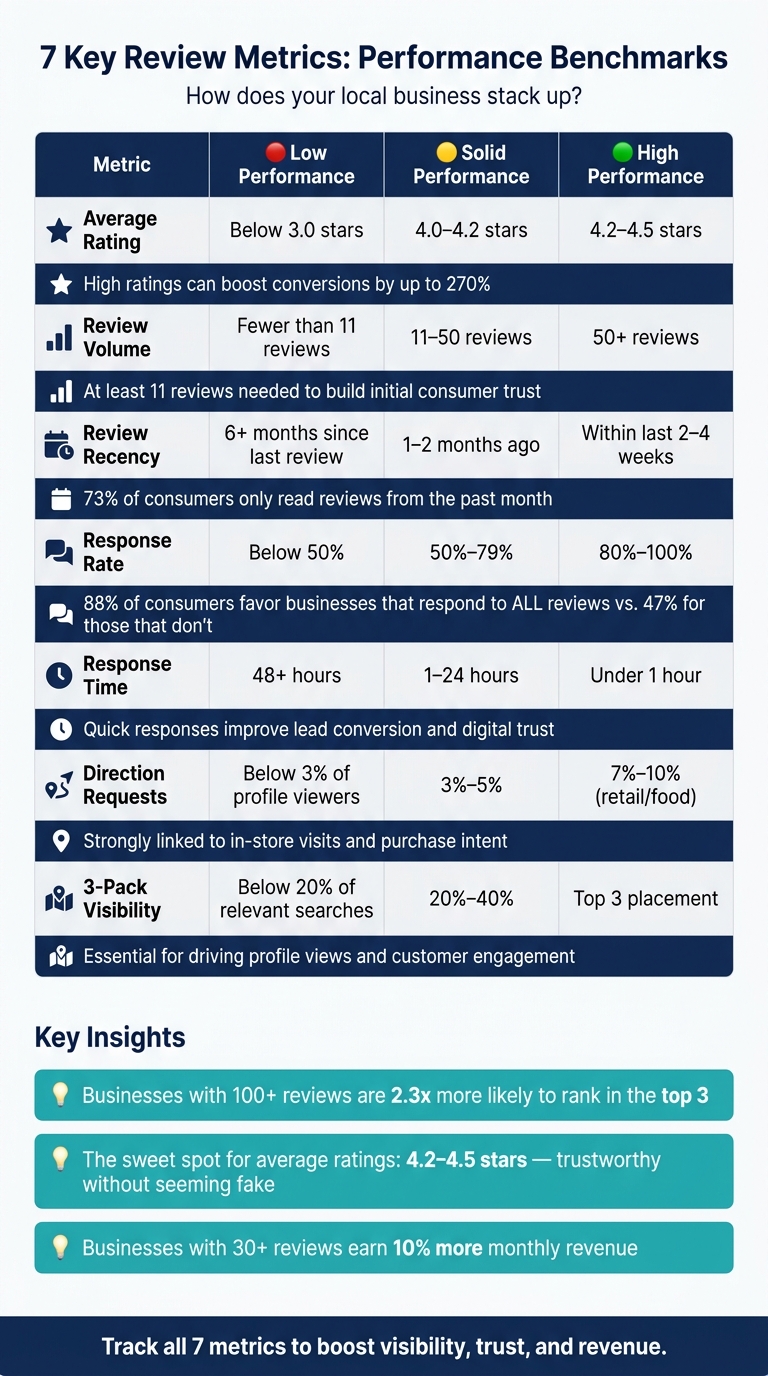
7 Key Review Metrics for Local Business Growth: Performance Benchmarks
Understanding how your business stacks up across key review metrics can help you identify areas for improvement. Below is a breakdown of seven critical metrics, their performance ranges, and their influence on local growth.
| Metric | Low Performance | Solid Performance | High Performance | Business Impact |
|---|---|---|---|---|
| Average Rating | Below 3.0 stars | 4.0–4.2 stars | 4.2–4.5 stars | High ratings can boost conversion rates by up to 270% |
| Review Volume | Fewer than 11 reviews | 11–50 reviews | 50+ reviews | Having at least 11 reviews builds initial consumer trust |
| Review Recency | 6+ months since last review | 1–2 months | Within the last 2–4 weeks | Older reviews can signal inactivity, reducing consumer confidence |
| Response Rate | Below 50% | 50%–79% | 80%–100% | 88% of consumers favor businesses that respond to all reviews, compared to 47% for those that don’t |
| Response Time | 48+ hours | 1–24 hours | Under 1 hour | Quick responses enhance digital trust and improve lead conversion |
| Direction Requests | Below 3% of profile viewers | 3%–5% | 7%–10% (retail/food) | Strongly linked to in-store visits and purchase intent |
| 3-Pack Visibility | Below 20% of relevant searches | 20%–40% | Top 3 placement | Essential for driving profile views and customer engagement |
Key insights from the data: Response rate stands out as a critical factor. Businesses that move from ignoring reviews to responding to all of them nearly double the percentage of consumers willing to visit. Similarly, review volume creates a trust threshold - businesses with fewer than 11 reviews often struggle to gain credibility, no matter how high their average rating is.
The sweet spot for average ratings lies between 4.2 and 4.5 stars. This range feels trustworthy - impressive enough to attract customers without appearing fake. Interestingly, a perfect 5.0 rating with just a few reviews can sometimes raise doubts, while a 4.3 rating backed by 80+ reviews tends to inspire more confidence.
"A majority of shoppers need to see at least 11 reviews before they will trust their validity." - AgencyAnalytics
This table serves as a practical guide. If your response rate is below 50% or your last review is outdated, addressing these gaps could significantly improve both your search visibility and conversion rates. Use it to prioritize your review management strategy effectively.
Conclusion
Keeping an eye on these seven review metrics - volume, average rating, recency, response rate/time, sentiment, review-driven actions, and local search visibility - provides a clear snapshot of your online reputation and highlights areas that need attention. Here's a compelling stat: businesses with over 30 reviews typically see 10% more revenue per month than those with fewer. Plus, improving your rating from 3 stars to 5 stars can result in 25% more clicks from Google's local pack. While these metrics have the potential to significantly impact revenue and engagement, staying consistent with monitoring can be tricky.
The real hurdle? It’s not about understanding what to measure - it’s about finding the time to do it regularly. That’s where tools like CommentAssist come into play. This AI-powered platform takes the hassle out of review management, automating monitoring and even generating responses for platforms like Google Business Profile and Yelp. With this tool, you can maintain the 80%+ response rate that experts recommend - without sinking hours into manual work.
"A negative review that has been handled correctly can be as much of a positive spotlight on the brand as a glowing review." - AgencyAnalytics
Take a moment to review the comparison table, pinpoint your weakest metric, and make it your priority. Whether it’s cutting down response time or increasing review recency, focusing on these areas can help you strengthen your online reputation and improve visibility in local searches.
FAQs
What’s a realistic monthly review goal for my business?
Consistently aiming to gather 3–5 new reviews each month is a solid target. Steady growth in reviews not only enhances your local SEO but also helps improve your visibility, which can contribute to the long-term success of your business. By regularly monitoring your review metrics, you can ensure you're making progress in strengthening your online presence.
How should I respond to a negative review without hurting SEO?
Handling negative reviews can be tricky, but if done right, it can actually work in your favor. The key is to stay professional while being strategic.
Start by replying within 24 to 48 hours - this shows you care and are attentive. When crafting your response, make it personal. Address the reviewer by name (if possible) and refer to the specific concerns they mentioned. This not only feels genuine but also helps build trust.
Here’s a bonus tip: include natural keywords related to your business, location, or services in your reply. For example, if you’re a coffee shop in Austin, Texas, you might mention something like, “We’re sorry your visit to our Austin coffee shop didn’t meet expectations.” This subtle touch can boost your local SEO while keeping your response authentic.
Above all, keep your tone respectful and solution-focused. Apologize where necessary and offer to resolve the issue. A well-thought-out reply can not only improve your reputation but also support your SEO efforts by showing search engines that you actively engage with customers.
How can I track calls and sales that come from Google reviews?
To connect Google reviews with calls and sales, focus on tracking metrics that bridge online feedback with offline activity. One effective method is using call tracking by assigning unique phone numbers to your Google Business Profile. This allows you to directly link incoming calls to specific reviews.
Additionally, keeping an eye on review growth and engagement can shed light on how these reviews impact your sales. By combining tools for review management with call tracking, you'll gain a clearer picture of how reviews drive customer inquiries. This insight can help refine your approach to boost offline conversions.